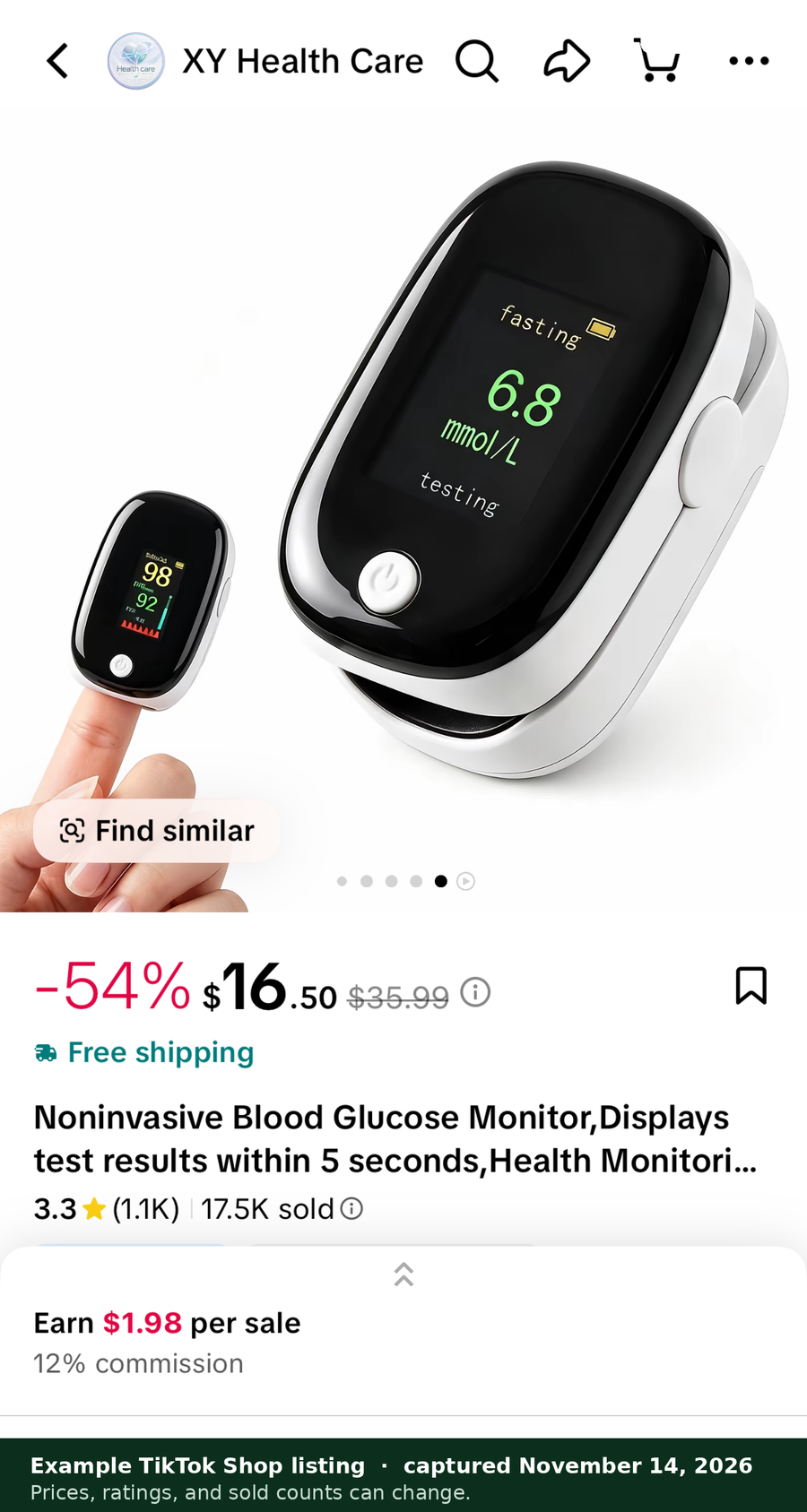
This one hit a nerve. I saw a TikTok Shop listing from a seller named XY Health Care for a “Noninvasive Blood Glucose Monitor,” advertised as displaying test results within five seconds. The price on the screen was $16.50, marked down from $35.99 — a 54% off badge. It showed 3.3 stars from 1.1K ratings, and 17.5K sold. The product photo is a fingertip clip, the same shape as the pulse oximeter a nurse slips on your finger, showing a reading of “fasting 6.8 mmol/L.” The listing also offered promoters a 12% commission, or $1.98 per sale.
I’m describing what was on the screen when I captured it on November 14, 2026. Prices, ratings, and sold counts can change. I did not buy the device, and I did not take it into a lab. I’m also not here to accuse that seller, or any other seller, of a crime. I am here to tell you what the U.S. Food and Drug Administration has already said about gadgets that claim to measure blood sugar without piercing the skin — and why a listing like this should make you pause, especially if you or someone you love uses insulin or other diabetes medicine.
On this one, here’s the line I keep coming back to:
If a $16 clip claims to measure your blood sugar without a drop of blood or an FDA-authorized sensor, don’t trust the number — and don’t use it to take medicine.
What the ads promise
The pitch is usually some version of this: clip this on your finger, or wear it as a watch or a ring, and you’ll get your blood sugar in a few seconds, with no finger stick and no sensor under the skin. The price looks like a bargain. The sold count looks like social proof. And the videos you see in your feed may not mention that the person promoting it can earn a commission on every sale.
On the listing I saw, “17.5K sold” is a lot of people who may believe they bought a medical device. A 3.3-star rating from more than a thousand reviews is not a number I’d want attached to something I used to decide on medicine. And 6.8 mmol/L, the number in the product photo, is a blood-sugar unit used in many countries. In the units most U.S. meters show, that’s about 122 mg/dL. I’m explaining the unit. I’m not saying the gadget actually measured anyone’s blood sugar.
What the FDA already warned us about
On February 21, 2024, the FDA issued a safety communication with a plain title: “Do Not Use Smartwatches or Smart Rings to Measure Blood Glucose Levels.” The agency warned consumers, patients, caregivers, and health care providers not to buy or use smartwatches or smart rings that claim to measure blood glucose — blood sugar — without piercing the skin. Those devices, the FDA said, may be sold through online marketplaces or directly from the seller.
The FDA was direct about the authorization question. It said it “has not authorized, cleared, or approved any smartwatch or smart ring that is intended to measure or estimate blood glucose values on its own.” It also said these devices “do not directly test blood glucose levels,” and that their safety and effectiveness have not been reviewed by the FDA.
The warning does not apply to a different kind of product: smartwatch apps that simply display readings from an FDA-authorized device that does pierce the skin, such as a continuous glucose monitor, or CGM. That’s a real sensor, reviewed by the FDA, sending a number to a phone or a watch. It is not the same thing as a gadget that claims to read your blood sugar all by itself, through the skin, with no sensor and no blood test.
I want to be precise, because the listing I saw isn’t a watch or a ring. It’s a fingertip clip. The FDA’s written warning names watches and rings. I could not find, in the FDA’s consumer communications I checked, any authorized, cleared, or approved device that measures blood glucose without piercing the skin. The claim on this clip is the same idea the FDA was warning about: a blood sugar number with no needle, sold on an online marketplace. I did not see an FDA clearance or authorization number on the part of the listing I captured.
Why the number matters
This is not like overpaying for a pair of earbuds that don’t translate as well as the ad suggested. If you live with diabetes, a wrong number can be dangerous.
The FDA said that for people with diabetes, inaccurate blood glucose measurements can lead to errors in diabetes management, including taking the wrong dose of insulin, sulfonylureas, or other medications that can rapidly lower blood glucose. Taking too much of those medicines, the agency said, can quickly lead to dangerously low glucose — hypoglycemia — “leading to mental confusion, coma, or death within hours of the error.”
That’s why I’m writing this for families and for older adults who are just trying to make life a little easier. I understand the appeal. Nobody enjoys a finger stick. A $16 clip that promises to skip all that is going to get attention. But ease is not the same thing as a reading you can trust, and it is not worth gambling with a parent’s insulin dose.
A short note on medical advice
This article is for consumer education. It is not medical advice, and it is not a diagnosis or a treatment plan. I am not a doctor. Talk with your health care provider before you change how you check your blood sugar or how you take diabetes medicine. If you think you or someone near you is having a medical emergency, including severe low blood sugar, call 911.
How to spot listings like this
These products show up on TikTok Shop and on other online marketplaces. The packaging and the brand names change. A few patterns are worth watching for:
- The listing promises a “noninvasive,” “no-prick,” or “no blood” glucose reading, often in a few seconds.
- The device looks like a pulse oximeter, a cheap smartwatch, or a smart ring — not like an FDA-authorized meter or CGM your clinic would recognize.
- The price is a bargain, often with a big markdown, and a high “sold” count is used as proof that it works.
- You don’t see an FDA clearance, authorization, or approval number — the kind of identifier that starts with a 510(k) number, a De Novo number, or a PMA number. A seller’s own “certified” badge is not the same thing. You can look up device clearances on the FDA’s own site.
- The listing offers creators a commission to promote it. That doesn’t automatically mean the product is a fraud. It does mean the enthusiastic video in your feed may be a paid pitch, not a medical review.
What I’d use instead
If you need to know your blood sugar, talk with your doctor or your diabetes care team about a method they stand behind. The legitimate options are not mystery clips from a marketplace video. They are:
- An FDA-cleared blood glucose meter that uses a small drop of blood from a finger stick. It isn’t glamorous. It is a real test.
- An FDA-cleared continuous glucose monitor, such as devices in the Dexcom and FreeStyle Libre families. These still use a small sensor that sits just under the skin. That’s what makes them different from a $16 clip. I’m naming types of FDA-cleared devices so you can have a conversation with your doctor. I’m not telling you which one to buy, or where to buy it.
In March 2024, the FDA also cleared the first over-the-counter continuous glucose monitor in the United States, the Dexcom Stelo Glucose Biosensor System, for adults 18 and older who do not use insulin and who do not have problematic hypoglycemia. Even that device uses a wearable sensor, not a clip that reads glucose through the skin. The FDA said users should not make medical decisions based on its output without talking to their health care provider, and that it is not designed to alert someone to dangerous low blood sugar. “Over-the-counter” does not mean “no sensor,” and it does not mean a product is right for everyone.
If you already bought one of these noninvasive gadgets, my advice is simple: don’t use its readings to take or skip medicine. Talk to your doctor about a device that’s actually authorized for the job.
If you want to report it
If you think you had a problem with an inaccurate reading, or you had any adverse event after using an unauthorized gadget like this, the FDA asks people to report it through MedWatch, the agency’s safety reporting program. You can start with the MedWatch Voluntary Reporting Form.
If you believe a listing is a scam or a bad business practice, you can also report it to the Federal Trade Commission at ReportFraud.ftc.gov. The FTC uses those reports to spot patterns; it doesn’t promise to resolve your individual complaint. It’s still worth filing, and it’s worth reporting the listing to the marketplace too.
My verdict
I’d call this a hard pass — and a serious one. A cheap clip that claims to measure blood sugar without a blood test or an FDA-authorized sensor is not something to trust with your health. The FDA has already warned people not to use watches and rings that make this kind of claim. The same caution belongs on a fingertip gadget that promises the same thing. If you need to know your blood sugar, use a method your doctor stands behind.
This is a recurring segment
Is It a Scam? is a regular part of The Mark Hope Show, with a matching page here on the site. If there’s a product you’re seeing everywhere and you want me to look at it next, tell me on the Ask Mark page. I can’t review everything, and I won’t invent a conclusion I can’t stand behind. But if I can help one family pause before they trust a $16 gadget with a parent’s insulin, that’s worth doing.
Sources
I re-checked these pages on November 14, 2026. The marketplace listing details come from a screenshot captured the same day. Prices, ratings, sold counts, and commissions change, so don’t treat those figures as current if you’re looking at a live page.
- U.S. Food and Drug Administration, safety communication, February 21, 2024, “Do Not Use Smartwatches or Smart Rings to Measure Blood Glucose Levels,” including the statement that the FDA has not authorized, cleared, or approved any smartwatch or smart ring intended to measure or estimate blood glucose on its own, the warning about wrong doses of insulin or other medicines, and the risk of mental confusion, coma, or death from severe hypoglycemia: FDA safety communication
- FDA MedWatch Voluntary Reporting Form, the reporting link given in that safety communication: MedWatch online form
- FDA, “MedWatch Forms for FDA Safety Reporting,” including the same online voluntary reporting link: MedWatch forms page
- Federal Trade Commission, ReportFraud.ftc.gov, the federal site for reporting fraud, scams, and bad business practices: ReportFraud.ftc.gov
- FDA press announcement, March 5, 2024, “FDA Clears First Over-the-Counter Continuous Glucose Monitor,” on the Dexcom Stelo Glucose Biosensor System — a wearable sensor, not a noninvasive clip, for adults 18 and older who do not use insulin and do not have problematic hypoglycemia: FDA announcement
- FDA, “510(k) Clearances,” the agency’s starting point for looking up device clearances: FDA 510(k) clearances page